
Why this question deserves a better answer
Search is no longer a single list of ten blue links. People discover businesses through ordinary search, AI-supported answers, professional networks and recommendations. Yet the underlying requirement remains familiar: information must be accessible, accurate, useful and supported by genuine experience.
For B2B marketers building long-term topic authority, the immediate challenge is not merely finding a vendor, producing another campaign or adjusting a design. The strongest content asset answers a real question using information the author can defend. AI discovery increases the importance of clarity, source quality and distinct knowledge rather than reducing it. A sound decision starts by asking which part of the current customer journey deserves attention, and what evidence would show that the work helped.
No outside consultant can guarantee inclusion in a proprietary AI answer. The responsible approach is to make useful content discoverable, clarify brand identity, publish evidence and measure observable results carefully. Search systems change, answer wording changes, and different users may receive different results. A report should acknowledge those limits rather than converting them into a made-up ranking.
The useful distinction: this is a guide to choosing and implementing a workable approach, not a promise of a fixed number of leads, sales or AI citations. What works depends on the actual customer, channel, offer and internal capacity.
A practical five-part framework for content marketing for AI search
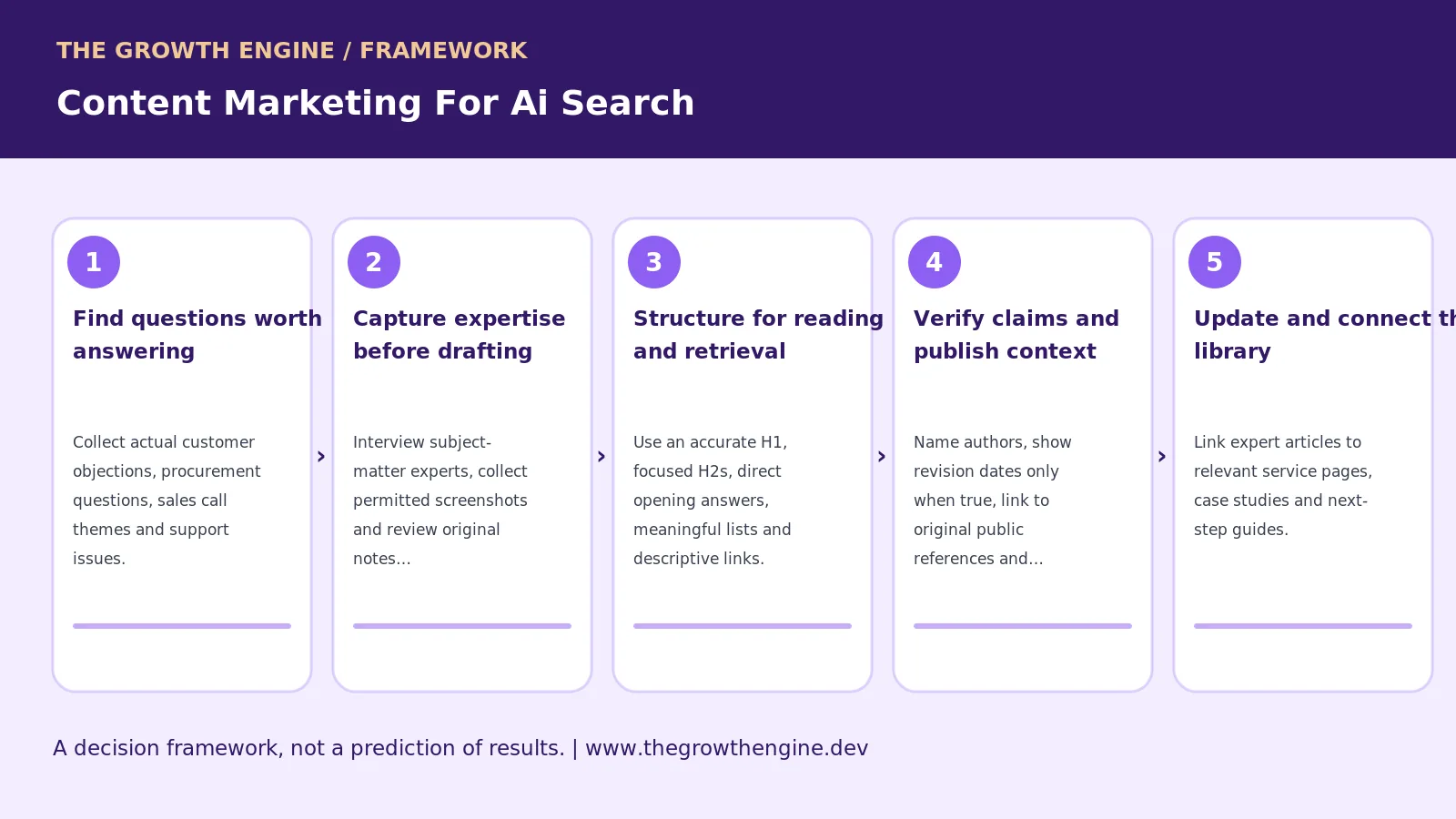
1. Find questions worth answering
Collect actual customer objections, procurement questions, sales call themes and support issues. Group by decision stage.
The decision to make: Search volume alone cannot reveal which answers matter to a buyer.
2. Capture expertise before drafting
Interview subject-matter experts, collect permitted screenshots and review original notes or data.
The decision to make: A page should contain at least one useful element another publisher cannot easily paraphrase.
3. Structure for reading and retrieval
Use an accurate H1, focused H2s, direct opening answers, meaningful lists and descriptive links.
The decision to make: Good structure makes content understandable to people and search systems.
4. Verify claims and publish context
Name authors, show revision dates only when true, link to original public references and disclose illustrative examples.
The decision to make: Correct information and honest uncertainty are part of credibility.
5. Update and connect the library
Link expert articles to relevant service pages, case studies and next-step guides. Refresh material when products or rules change.
The decision to make: A coherent knowledge base supports deeper evaluation than isolated posts.
What this looks like in a realistic situation
Illustrative example, not a client result: A SaaS founder can contribute firsthand lessons about onboarding objections, while an agency editor provides structure and source checking. That collaboration produces something more defensible than generic “ten tips” content.
The first improvement is to describe the visitor’s decision precisely. Then identify what information is missing and choose a single change that can be evaluated honestly. Avoid inventing a percentage uplift or claiming that a mock scenario represents actual results. A well-framed illustration helps readers understand the method; a documented case study requires real work, permission and substantiated outcomes.
Mistakes that quietly undermine the work
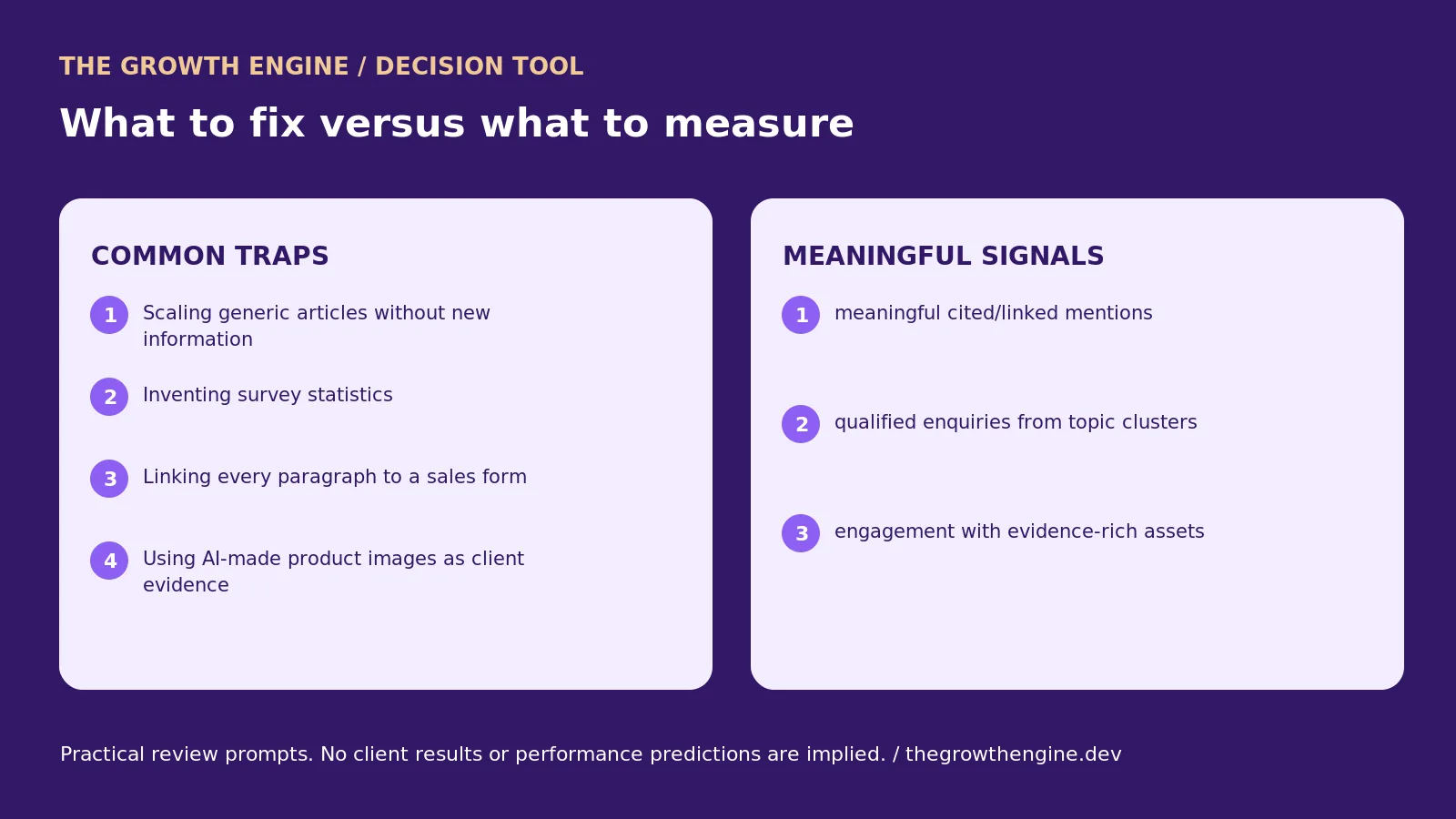
1. Scaling generic articles without new information. Scaling generic articles without new information tends to distract from the actual buying decision. A better review asks what a relevant prospect knows at this point, what remains uncertain and whether the next action is clear. Resolve the underlying problem with specific, verified information before investing in a larger production calendar.
2. Inventing survey statistics. Inventing survey statistics tends to distract from the actual buying decision. A better review asks what a relevant prospect knows at this point, what remains uncertain and whether the next action is clear. Resolve the underlying problem with specific, verified information before investing in a larger production calendar.
3. Linking every paragraph to a sales form. Linking every paragraph to a sales form tends to distract from the actual buying decision. A better review asks what a relevant prospect knows at this point, what remains uncertain and whether the next action is clear. Resolve the underlying problem with specific, verified information before investing in a larger production calendar.
4. Using AI-made product images as client evidence. Using ai-made product images as client evidence tends to distract from the actual buying decision. A better review asks what a relevant prospect knows at this point, what remains uncertain and whether the next action is clear. Resolve the underlying problem with specific, verified information before investing in a larger production calendar.
What should you measure?
A reporting framework should begin with a practical definition of success for B2B marketers building long-term topic authority. Three useful indicators to consider are meaningful cited/linked mentions, qualified enquiries from topic clusters, and engagement with evidence-rich assets. These indicators have different roles: some describe immediate behaviour, others reflect lead suitability or a downstream commercial step. Agree on the definitions before the reporting period begins and keep the underlying denominators visible.
For a Indian business, measurement also needs human review. An enquiry may appear valid in analytics yet be outside the service area or product fit. A call may be valuable even when it is not attributed to the last web session. Compare digital events with the sales or customer-service team’s observations, document missing data and resist turning uncertain attribution into a precise-sounding revenue claim.
Build a modest baseline first. Note the observation window, relevant channels, available traffic and any technical limitations. Review progress after enough meaningful interactions have occurred. A change in one metric is a signal for investigation, not automatic proof that a particular headline, article or graphic caused the difference.
Questions to ask before hiring an agency or allocating budget
Ask who will do the work, which deliverables are included, what evidence supports its recommendations, and what your team must contribute. Request a transparent proposal with scope, timeline, approvals, reporting, account ownership and third-party costs. If the agency claims expertise in content marketing for AI search, ask it to explain your situation using real buyer questions rather than showing a generic slide deck.
For The Growth Engine, a relevant starting point is the ai solution area and the connected buyer-journey approach. These pages describe how positioning, discovery, conversion and follow-up can work together. Explore the methodology, then agree a scope before assuming the service is the right fit.
SEO, AEO and GEO are practical approaches, not certification standards or guaranteed access routes. Treat crawler guidance as product-specific and subject to change. Structured data should describe visible facts and cannot substitute for original expertise or independent corroboration.
A seven-day working plan
Day 1: Write down one commercial objective and the customer group you can realistically serve. Day 2: Speak with someone who handles enquiries and record the five questions customers ask most often. Day 3: Review the most relevant public page or conversation path against those questions. Day 4: Collect the truthful photographs, screenshots, specifications, expert input or process evidence needed to improve the answer.
Day 5: Draft one focused improvement and ask an informed colleague to try the journey on a phone. Day 6: Correct misleading language, technical friction and unclear next steps. Day 7: Publish, check that enquiries actually reach the right person, record the starting measurement and decide what to learn next. This creates a useful first cycle; it does not replace an appropriately scoped longer engagement.
The next step
FAQs
What is the first thing to check before investing in content marketing for AI search?
Start with the customer action that matters and trace backwards. Identify who should take it, what they need to understand and where the existing journey creates doubt. Review actual enquiries and sales feedback before choosing channels or design changes. The initial decision should be specific enough that a small improvement can be evaluated.
How quickly should a business expect results from content marketing for AI search?
The timeframe depends on the starting point, audience, traffic, purchase cycle and chosen deliverables. Some messaging or usability fixes can be implemented promptly, while search visibility and commercial outcomes may require extended observation. Set implementation milestones separately from performance expectations. No responsible agency should promise the same timeline or outcome for every business.
What makes an approach to content marketing for AI search credible?
A credible plan names the intended buyer, shows the information the buyer needs, describes exactly what will be created or improved and explains how it will be evaluated. It distinguishes proven facts from assumptions, uses original expertise and does not invent case-study results. Ask who owns the deliverables and what data the business will be able to inspect.
Can The Growth Engine help with content marketing for AI search?
The Growth Engine describes services spanning positioning, qualified demand, content, SEO and AI search, conversion-focused websites and sales enablement. The appropriate starting point depends on the industry and the specific bottleneck. Review the relevant service page and discuss your actual audience, offer, website and desired outcome before commissioning work.
Which metrics matter most for content marketing for AI search?
The most relevant starting indicators for this topic include meaningful cited/linked mentions, qualified enquiries from topic clusters and engagement with evidence-rich assets. Define each carefully, record where data comes from and check the quality of the resulting enquiries or interactions. Avoid presenting clicks or impressions as sales results. The final measures should correspond to a real business decision. The right approach to **content marketing for AI search** should make something specific easier for your next suitable customer: understanding the offer, assessing fit, choosing a product, asking a well-informed question or progressing toward a purchase. Start with the part of the journey that currently creates the most friction. If you want help translating this framework into an actionable brief, explore [The Growth Engine](https://thegrowthengine.dev/) and its [relevant ai services](https://thegrowthengine.dev/solutions). Ask for a scoped review of your actual pages and enquiry path rather than an unsupported guarantee.