

Why “more leads” is often the wrong growth target
A lead count is easy to measure, which is exactly why it can become misleading.
A business can increase form fills and still make life harder for sales. The enquiries may be outside the ideal customer profile. They may be curious rather than commercially active. They may be too early, too small, poorly matched to the offer, or unclear about what the company actually does. In that situation, marketing reports activity while sales absorbs the cost of sorting it.
The better question is not “How do we get more leads?” It is “How do we create more relevant buying conversations?” That is the core of revenue-led growth strategy.
That shift changes the entire system. Positioning becomes a qualification tool. Content becomes a way to help the right buyer self-identify. Landing pages become decision pages. Forms capture useful commercial context. Nurture reduces uncertainty. Sales enablement helps the buyer move forward after the first conversation.
Qualified lead generation therefore starts before traffic arrives and continues after the lead is captured.
What makes a lead genuinely qualified?
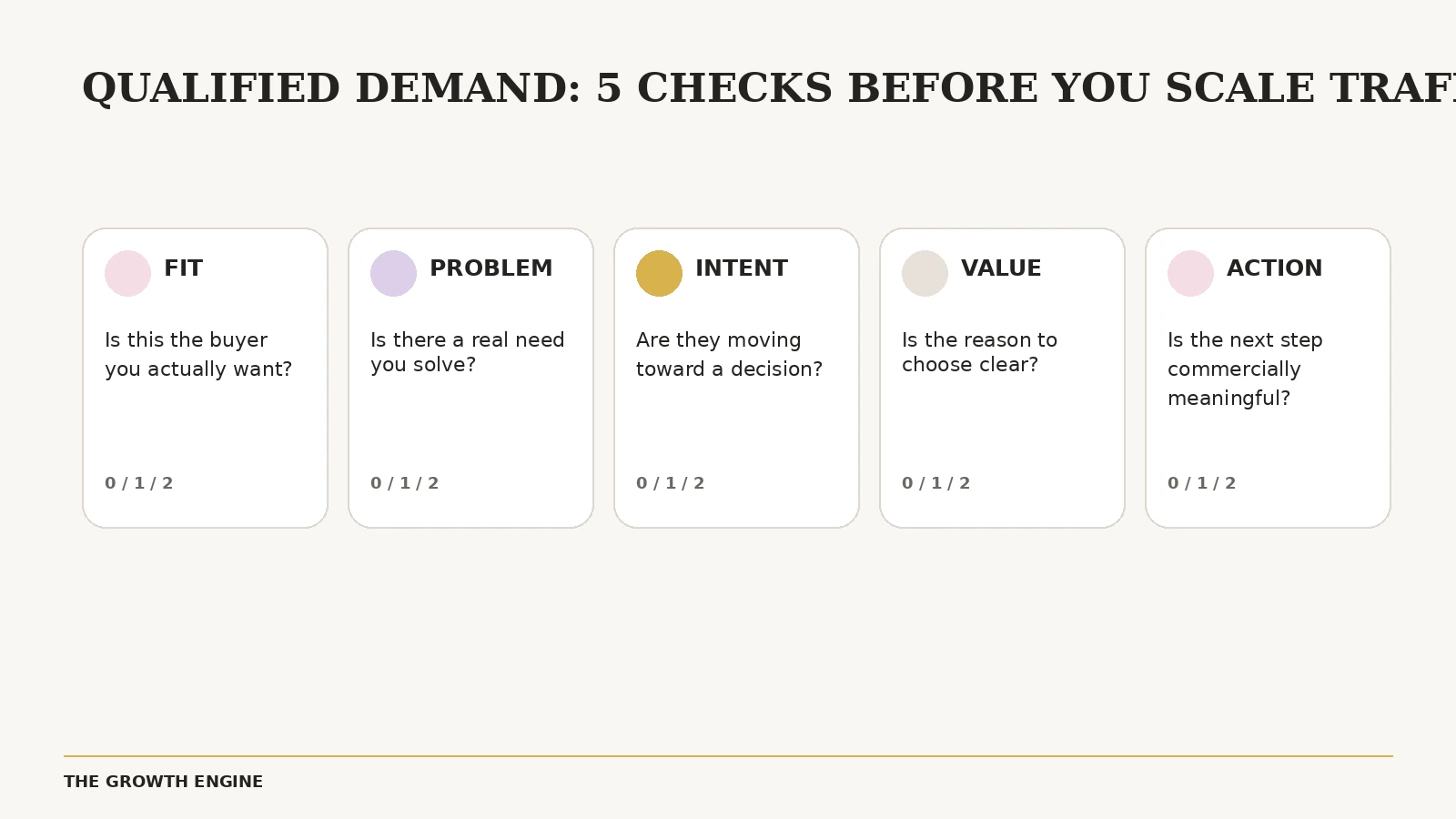
There is no single universal definition because qualification depends on the business model, deal value, sales cycle and buying process. But a practical definition can be built around five questions.
- Fit: Is this the kind of customer the business is designed to serve?
- Problem: Does the buyer have a problem or goal the offer genuinely addresses?
- Intent: Is there evidence that the buyer is actively evaluating, comparing or planning action?
- Ability: Can the buyer realistically move ahead in terms of budget, authority, timing or internal readiness?
- Action: Has the buyer taken a step that signals willingness to continue the commercial journey?
A person can match the ideal customer profile and still be unqualified today. A buyer can also show high intent but be a poor strategic fit. That is why qualification should combine who the buyer is with what the buyer is trying to do now.
For a B2B SaaS company, a qualified lead may be a company in the right segment with a defined workflow problem, relevant user volume and an active evaluation. For a jewellery business, qualification may look less like an MQL score and more like clear product or occasion intent, repeat engagement, WhatsApp interaction, store-visit behaviour or cart activity. For real estate, a useful lead may need project fit, location fit, budget range, timeline and willingness to schedule a conversation or visit. For packaging, a strong enquiry often includes application, quantity, material or format need, timeline and readiness to discuss an RFQ.
The mechanism differs. The principle does not: qualification should reflect the real buying journey.
The Growth Engine framework: FIT → INTENT → VALUE → FRICTION → HANDOFF
I use a simple five-part framework to diagnose lead-generation quality.
1. FIT — Are you attracting the right market?
Before increasing traffic, define who should recognise themselves in the message. A strong page makes the target buyer feel, “This is for a business like mine.” That usually requires more than an industry label. It can include business model, growth stage, team type, use case, problem, purchase context and commercial trigger. If the positioning is too broad, lead quality often becomes broad as well.
2. INTENT — What is the buyer trying to accomplish?
Search traffic, LinkedIn engagement, product-page visits, demo clicks and WhatsApp enquiries do not all mean the same thing. Map the intent behind the action. Is the buyer learning? Comparing? Validating? Shortlisting? Looking for pricing? Preparing a proposal? Trying to solve an urgent operational issue?
The content and CTA should match that intent. Asking a research-stage buyer for a sales call too early can suppress conversion. Giving a decision-stage buyer another generic ebook can waste high intent. This is where SEO and AI search and demand generation content need to be planned by intent.
3. VALUE — Is the reason to choose clear?
The buyer should not have to translate features into commercial value alone. A useful value proposition answers three questions quickly:
- What changes for the buyer?
- Why is this approach or company meaningfully different?
- What evidence reduces the risk of believing the claim?
This is where proof, case examples, comparisons, process transparency, samples, demonstrations and specific outcomes become useful. See how we approach this in our work.
4. FRICTION — What makes the next step harder than it needs to be?
Friction is not only a long form. It can be unclear pricing logic, vague CTAs, missing trust signals, generic proof, a confusing page structure, too many choices, poor mobile experience, slow response, or a form that asks questions before earning the right to ask them.
Conversion optimisation and better website design should remove unnecessary effort while preserving enough qualification to protect sales time.
5. HANDOFF — What happens after the lead is captured?
The form submission is a transition, not a victory. The buyer may still need a case study, comparison, technical answer, pricing explanation, sample, internal business case, site visit, consultation or follow-up sequence.
Marketing and sales should agree on what the buyer needs next. If every lead receives the same follow-up, the qualification work done before the form is partly wasted.
A simple revenue-first lead qualification scorecard
A useful scorecard does not need to be complicated. Start with five dimensions and rate each from 0 to 2.
| Dimension | 0 | 1 | 2 |
|---|---|---|---|
| Fit | Outside target | Possible fit | Strong ICP fit |
| Problem | No clear need | General interest | Specific relevant problem |
| Intent | Passive | Evaluating | Active next-step behaviour |
| Ability | Unknown / unlikely | Possible | Budget/authority/timing reasonably aligned |
| Action | No next step | Soft engagement | Demo, RFQ, consultation, visit, sample or equivalent |
The point is not the number itself. The point is consistency. A 9/10 lead should not be treated the same way as a 3/10 lead. High-intent prospects may need fast human response. Medium-intent prospects may need proof and nurture. Low-intent but high-fit prospects may belong in a longer education journey.
Most importantly, sales feedback should improve the scorecard. Qualification should evolve based on what actually becomes a meaningful sales conversation.
Example: 100 leads can be weaker than 25
Consider a hypothetical B2B service company.
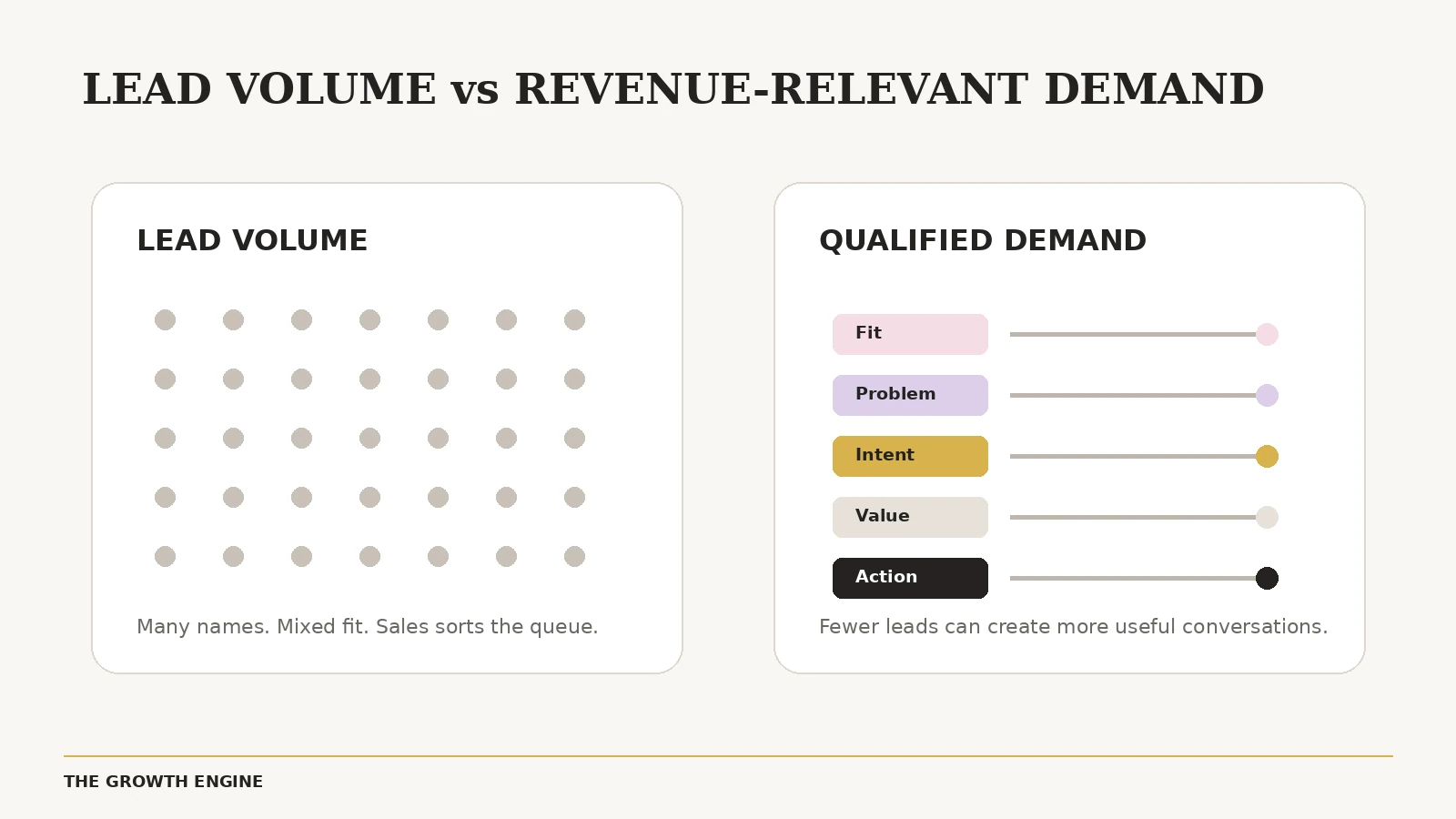
Campaign A produces 100 enquiries. Most came through a broad message promising “complete growth solutions.” Sales discovers that many are tiny businesses, job seekers, vendors and companies looking for unrelated services. Ten conversations are relevant.
Campaign B produces 25 enquiries. The landing page names the buyer type, the commercial problem, the process, the minimum level of readiness and the exact next step. Fifteen conversations are relevant.
Campaign A “won” on lead volume. Campaign B created more useful pipeline. This is why cost per lead is incomplete on its own. A lower CPL can coexist with a higher cost per qualified conversation. The more useful operating metrics are the ones that connect marketing activity with commercial progression.
What should you measure instead of raw lead volume?
The right measurement depends on the business, but a revenue-first dashboard usually needs a sequence rather than one headline number. Track:
- Visitors or reached audience
- Conversion to enquiry, demo, RFQ, consultation or other meaningful action
- Percentage that fits the target customer
- Percentage accepted as worth pursuing
- Response rate to the first follow-up
- Meeting, demo, site-visit, sample or proposal progression
- Opportunity creation
- Win rate where attribution is responsible and available
- Time between lead creation and first meaningful response
- Source and content that influenced the buyer journey
For self-serve or B2C models, replace sales stages with the real behaviour: sign-up, activation, product usage, trial-to-paid, purchase, repeat purchase, retention or expansion. The goal is to see where commercial momentum stops.
Five common lead-generation mistakes
Mistake 1: Buying traffic before fixing the message
If the value proposition is unclear, more traffic scales confusion.
Mistake 2: One CTA for every level of intent
A buyer who needs a benchmark, a sample, a pricing explanation and a demo may not be ready for the same next step.
Mistake 3: Treating every form fill equally
A single generic form creates a queue, not necessarily a pipeline.
Mistake 4: Letting sales create all the proof after the lead arrives
Marketing should reduce uncertainty before the call through content, examples, process clarity, case evidence, comparisons and buyer education.
Mistake 5: Optimising for marketing metrics in isolation
CTR, reach, impressions and CPL are useful diagnostic metrics. They become dangerous when they are mistaken for commercial success.
How to improve lead quality without immediately increasing ad spend
Start with the journey you already have.
- Review the homepage and top landing pages. Can the right buyer identify themselves quickly?
- Audit the CTA. Does it match the visitor's likely intent?
- Review the form. Does it capture useful qualification information without creating unnecessary friction?
- Look at the last 20–50 leads manually. What made the good ones good? What made the weak ones weak?
- Ask sales what objections repeat after the first call. Turn those objections into visible content.
- Add one piece of decision content: a comparison, process explainer, case example, calculator, checklist, sample or buyer guide.
- Tighten follow-up. The first response should reflect what the buyer actually asked for.
- Track movement from lead to meaningful next step, not only lead creation.
This exercise often reveals that the “lead-generation problem” is actually a positioning, conversion, qualification or enablement problem.
Where a lead generation agency should add value
A useful lead generation agency in India should not simply increase the number of people entering a database. It should help connect acquisition to revenue by improving:
- ICP and audience definition
- Positioning and messaging
- Search and demand-generation strategy
- Landing-page and website conversion
- Lead qualification
- Content for buyer evaluation
- Nurture and follow-up
- Sales enablement
- Measurement and feedback loops
That does not mean one agency must execute every function. It does mean the work should be designed around the complete commercial journey rather than optimising one disconnected channel.
The practical test
Before approving another campaign, content plan or traffic budget, ask:
If the right buyer lands here today, does the experience make it easier for them to recognise the problem, understand the value, trust the proof and take the correct next step?
If the answer is no, the first growth task may not be “get more leads.” It may be to make the existing journey better at producing the right ones.
No lead-generation framework guarantees lead volume, lead quality, conversion or revenue. The right qualification model depends on offer, market, buying cycle and sales process.
Frequently asked questions
What is qualified lead generation?
Qualified lead generation is attracting people or companies that fit the business, have a relevant problem, show meaningful intent and can realistically move toward a commercial decision — rather than collecting the largest possible number of enquiries.
What makes a lead genuinely qualified?
Five questions: Fit (is this the customer the business serves?), Problem (does the offer address their need?), Intent (are they actively evaluating?), Ability (budget, authority, timing, readiness) and Action (have they taken a step that signals they want to continue?).
What is the FIT → INTENT → VALUE → FRICTION → HANDOFF framework?
It is The Growth Engine's five-part diagnostic for lead quality: attract the right market, match content and CTAs to buyer intent, make the reason to choose clear, remove unnecessary friction, and plan what the buyer needs after the lead is captured.
Why can 100 leads be weaker than 25?
A broad message can produce many enquiries that are outside the ideal customer profile. A focused page that names the buyer, problem, process and next step may produce fewer leads but more relevant sales conversations — so lead volume and cost per lead alone are incomplete metrics.
What should I measure instead of raw lead volume?
Track the sequence: conversion to meaningful action, percentage that fits the target customer, percentage accepted by sales, first-response rate, meeting or proposal progression, opportunity creation, win rate where attribution is responsible, and time to first meaningful response.
How can I improve lead quality without increasing ad spend?
Review your top pages and CTAs, tighten the form, manually review your last 20–50 leads, turn repeated sales objections into content, add one piece of decision content, tailor follow-up and track movement from lead to next step.
What should a lead generation agency in India actually do?
A useful lead generation agency connects acquisition to revenue by improving ICP definition, positioning, search and demand strategy, landing-page conversion, qualification, buyer-evaluation content, nurture, sales enablement and measurement feedback loops.
Can any framework guarantee more qualified leads?
No. No lead-generation framework guarantees lead volume, lead quality, conversion or revenue. The right qualification model depends on the offer, market, buying cycle and sales process.
Audit My Lead Generation
Find where your current journey is attracting the wrong demand, losing the right buyers, or handing sales too little context to move the conversation forward.
Audit My Lead Generation