
Generic partner messaging
“Certified expert” says little about which business problem you solve.
CRM SaaS partner marketing agency
For businesses implementing, consulting on or reselling CRM platforms: sharper positioning, use-case content and demand journeys that attract buyers with a real deployment problem.

A CRM SaaS partner can attract qualified leads by specialising around specific buyers and use cases, publishing implementation proof and practical comparisons, and guiding prospects toward a scoped discovery call. Lead quality improves when marketing and sales agree on what makes a potential CRM project a good fit.
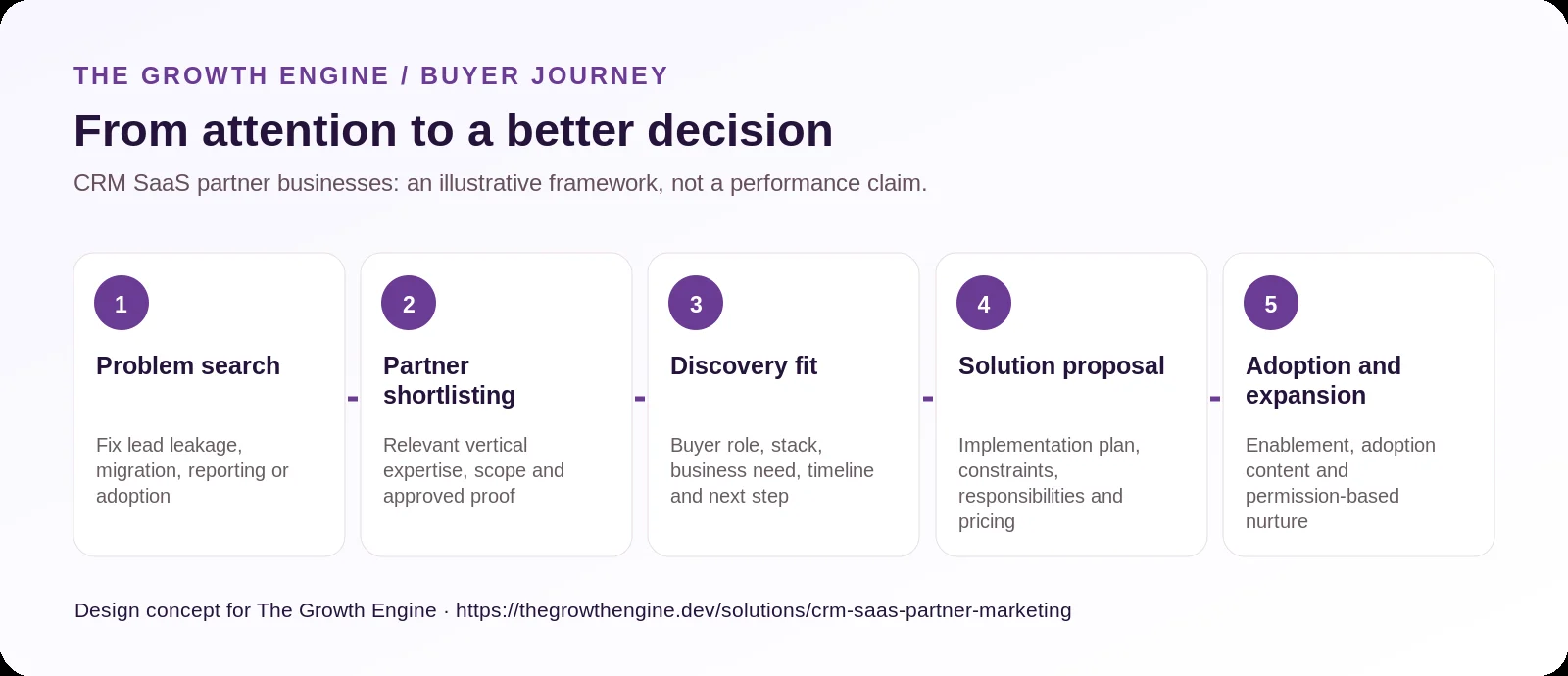
Buyers do not begin with “I need a CRM reseller.” They start with leaking leads, broken follow-up, scattered spreadsheets or a CRM rollout that never stuck. Your message needs to meet them there.
“Certified expert” says little about which business problem you solve.
Broad targeting attracts companies with no budget, urgency or implementation fit.
Use cases, implementation scope and change-management answers are missing.
How we help
Vertical, use-case and platform positioning that tells prospects when to choose you.
Migration explainers, implementation guides, comparison pages and founder-led expertise.
Landing pages and forms that establish team size, problem, timelines and fit.
Approved proof, follow-up, sales assets, CRM reporting definitions and nurture sequences. 
Measure progress, not noise
Define an opportunity by fit: industry, CRM platform, deployment size, urgency, commercial context and operational readiness. Track enquiries accepted by sales and real discovery progress, not just clicks.
Tell us your platform focus, ideal account and current funnel problem. We will suggest a practical starting point for positioning, content and conversion.
Related: qualified lead generation · SEO & AI search · client work · Growth Library
Common questions
A CRM SaaS partner marketing agency helps implementation consultancies, resellers and specialist service providers explain their expertise, reach suitable business buyers and improve the path to qualified discovery calls. For that reason, unlike broad consumer marketing, the message must often address operational problems, integration requirements, rollout risk and buying committees. Work may include positioning, vertical landing pages, search content, founder expertise, conversion-focused forms and sales-enablement material. The starting point is a precise definition of the ideal client and the types of projects the partner can genuinely deliver. A useful agency does not promise opportunities without considering service capability and fit.
Begin by naming the implementation situations you serve best, such as replacing spreadsheets, migrating from a legacy CRM or improving a sales process that has poor adoption. Build pages around those problems and explain the business context, your approach and a sensible discovery call. For an agency and its client team, support pages with clear scope, approved examples and common objections. Ask a small number of useful qualifying questions about company size, current systems, urgency and goals. Review which enquiries become suitable sales conversations and proposals. Lead volume matters less than whether prospects can benefit from your actual implementation capabilities.
It is usually easier to communicate a strong proposition when you understand the needs of a specific buyer group. A partner working with manufacturers may face different workflows from one serving professional services firms. You do not need to reject all other clients, but the public message should show depth where you have it. For a growing business today, choose verticals based on genuine delivery experience, demand, deal viability and available proof. Build dedicated use-case content only for segments you can support. Test the focus through discovery-call quality and sales feedback rather than assuming more industries always produce better growth.
A strong page states whom the partner serves, the operational problem it solves, the platforms and services it actually supports, and the next step for a buyer. For a business reviewing its current buyer journey, describe implementation, migration, automation or training boundaries clearly. Add approved proof, an explanation of the engagement process and common risk questions. Use plain language instead of an endless list of technology certifications. A discovery form should gather enough context for fit without becoming a procurement questionnaire. Keep the page fast on mobile and align it with the promise made in the advert or search result.
SEO can support visibility around the problems prospective clients research, from CRM migration to industry workflows and implementation comparisons. Prioritise specific pages that answer decision questions rather than generic articles repeating CRM benefits. For a growing business today, explain what the partner can deliver, what the buyer should prepare and where limitations exist. Use descriptive headings, strong internal links, accurate metadata and crawlable content. Search performance develops over time and depends on competition, authority and content quality. Measure qualified organic enquiries and opportunities, not only keyword positions. A useful article should help a reader decide whether a consultation is appropriate.
LinkedIn can make practical experience visible before a buyer starts a formal search. Share concise examples of business problems, rollout lessons, change-management mistakes and questions prospective clients should ask. Use client details only with permission and avoid claiming a platform endorsement you cannot document. In a focused first planning discussion, a founder or delivery lead can translate technical experience into language a finance, sales or operations leader understands. Connect useful insights to relevant solution pages rather than turning every post into a sales pitch. Track the quality of resulting conversations while accepting that buyers may engage over a longer cycle.
Decision-stage content often answers uncomfortable but important questions: how migration works, what data cleansing involves, who owns configuration, how integrations are scoped and how users will be trained. At the beginning of a more deliberate growth project, comparison pages, implementation checklists and industry workflow explainers can all help when they are accurate. Offer an assessment or discovery call with a clear purpose instead of an undefined consultation. Use delivery-team expertise to review claims before publishing. The most useful content prepares a prospective buyer for a realistic conversation and helps internal stakeholders understand the value, responsibilities and constraints of the project.
Competing only on size or price rarely explains why a buyer should choose a smaller specialist. Make your advantages concrete: a defined sector, a particular workflow, a responsive implementation model or relevant experience with a specified stack. For a growing business today, explain what you do not cover as well as what you do. Show approved examples of project thinking without inventing client outcomes. Smaller teams can sometimes offer a clear line to senior practitioners, but only promise that when operationally true. Strong positioning makes it easier for suitable buyers to recognise fit and for unsuitable buyers to self-select out.
Yes. A problem-led message can start with lead leakage, reporting gaps, poor adoption or disconnected processes. However, the site should still clarify which platforms, tools and deployment environments the partner supports wherever that information affects buying decisions. To make the next decision more useful to the buyer, do not imply a formal partnership or certification with a CRM vendor unless it is current and verified. Explain capabilities plainly, distinguish consulting from resale and implementation, and clarify whether licences or subscriptions are included. The goal is to attract enquiries the team can actually handle and reduce uncertainty before a discovery conversation.
Qualification is specific to delivery capability. In a focused first planning discussion, a useful lead may have a business problem you can solve, a relevant software environment, a feasible timeline and access to people who can define requirements. Company size, industry and budget context can matter, but overly rigid forms may block promising conversations. Agree on qualification with sales and implementation leads before launching campaigns. Mark accepted and rejected enquiries consistently, then review reasons rather than judging only volume. A good lead is not a person who clicked an advertisement; it is a plausible opportunity for a productive commercial discussion.
Start with reliable stages: source, enquiry, qualified discovery, accepted opportunity, proposal and closed work where records are available. Define each stage before attributing value to campaigns. For a business reviewing its current buyer journey, review lead fit, sales-cycle length, opportunity quality and acquisition costs alongside eventual contract economics. Some deals involve multiple touchpoints, so last-click reporting can be misleading. Document data gaps openly and keep implementation capacity in mind. If a campaign brings projects the team cannot profitably deliver, a flattering lead count is not success. Use measurement to improve targeting, offers and follow-up decisions rather than inventing precise returns.
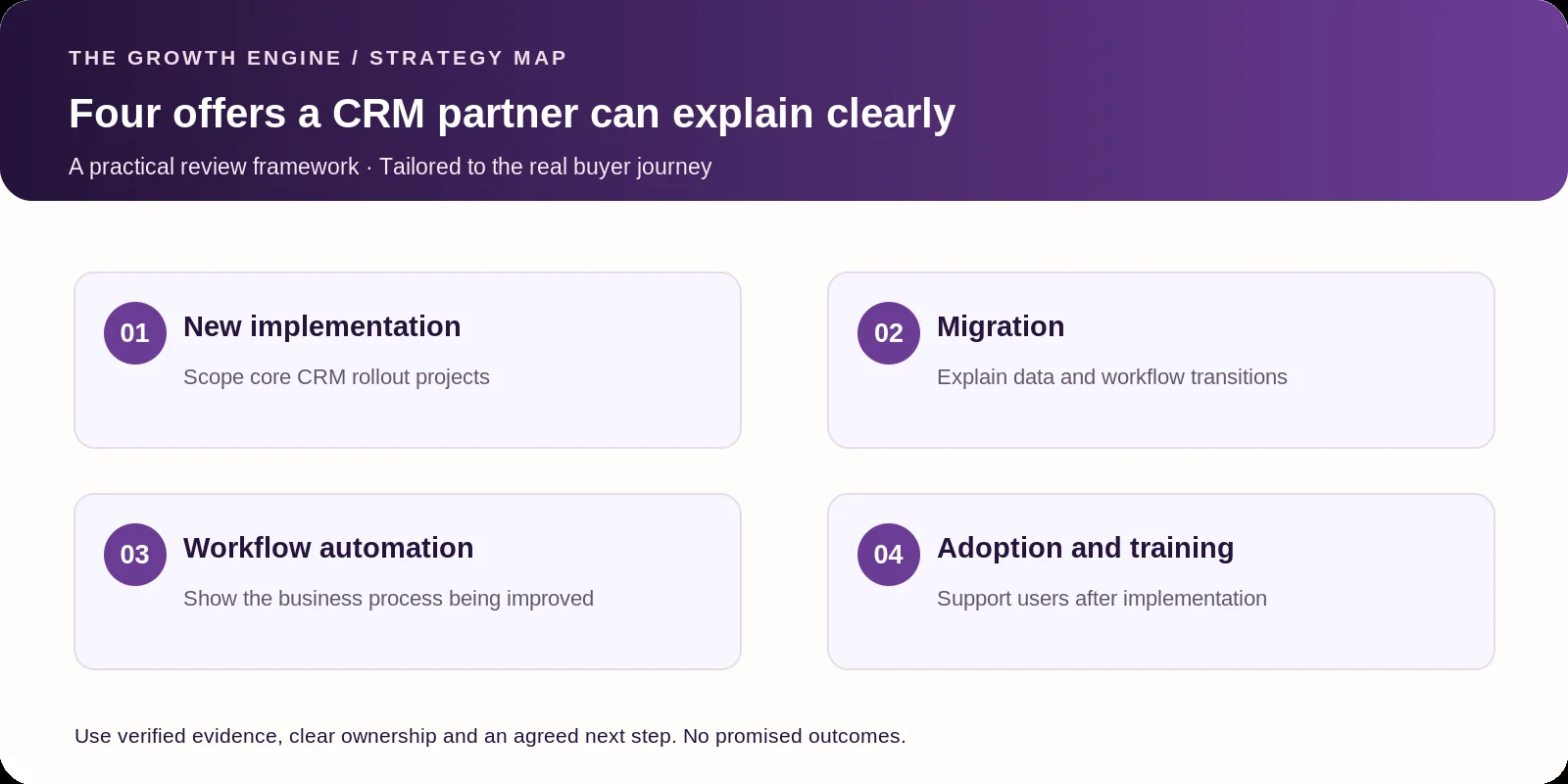
Separate pages can help when each service answers a genuinely different buying question. A prospect seeking a new CRM implementation may need planning and rollout information, while migration buyers need data risk and transition details. An adoption buyer may want training and workflow support. At the beginning of a more deliberate growth project, keep the overall brand message coherent, then describe each service with its actual scope, prerequisites, deliverables and decision steps. Avoid creating near-duplicate pages with only keywords changed. The distinction is valuable when it helps a buyer understand what you do and request the right type of conversation.
Explain business workflows and the limits of the proposed solution before discussing automation features. From a buyer's perspective, show what information enters the system, who uses it, what manual review may remain and how success would be evaluated. Avoid promising that automation can replace every process or guarantee revenue. Any demonstration should clearly distinguish illustrative concepts from deployed client systems. Work with delivery teams to validate integrations, security statements and technical feasibility. A responsible campaign gives buyers enough information to ask good questions and understand that process change, data quality and user adoption influence results as much as software configuration.
Yes. CRM decisions may require input from sales, operations, IT, finance and senior leadership. In a focused first planning discussion, relevant follow-up can answer different concerns without pushing every stakeholder through the same generic sequence. A sales leader may want pipeline visibility; an administrator may need data hygiene guidance; a finance lead may ask about implementation scope and ongoing costs. With permission, send concise resources that match the stage and known interest of the buyer. Monitor engagement and sales feedback while respecting communication preferences. Nurture supports informed decisions but does not remove the need for accurate scoping and capable delivery.
We begin by understanding which CRM projects your team can deliver, which accounts are a fit and where your existing funnel loses opportunities. The review may examine positioning, website pages, content, lead sources, qualification and sales follow-up. Together we can prioritise a specific use case or vertical, then define the messaging and assets worth creating. In a focused first planning discussion, possible work includes search content, landing pages, LinkedIn thought leadership, conversion improvement and sales-enablement material, subject to a clear agreement. We do not claim a formal relationship with any CRM software vendor or guarantee rankings, leads or revenue outcomes.