
Same-looking content
Generic jewellery posts fail to communicate your distinctive style and use case.
demi fine jewellery marketing agency
For modern everyday, gifting and occasion jewellery brands: turn beautiful drops into memorable stories, confident product choices and more meaningful orders.

Demi-fine jewellery brands can grow by pairing distinctive styling content with truthful material descriptions, product pages that reduce hesitation, targeted discovery and repeat-purchase journeys. The goal is not only more views but more customers who understand the product and want to buy it.
A new collection looks beautiful on Instagram. Then customers ask about tarnish, size, materials, delivery and returns. If those answers are buried in DMs, conversion loses momentum.
Generic jewellery posts fail to communicate your distinctive style and use case.
Material, scale, plating, care and return details are hard to find.
Gifting, restock and post-purchase relationships are not thoughtfully connected.
How we help
An editorial system for your signature pieces, styling occasions and visual language.
Reels, wearable styling guides, product-scale visuals and collection narratives.
Clear materials, accurate size references, useful policies, cleaner PDPs and high-intent CTAs.
Gifting flows, consent-based follow-up, customer education and thoughtful repeat discovery. 
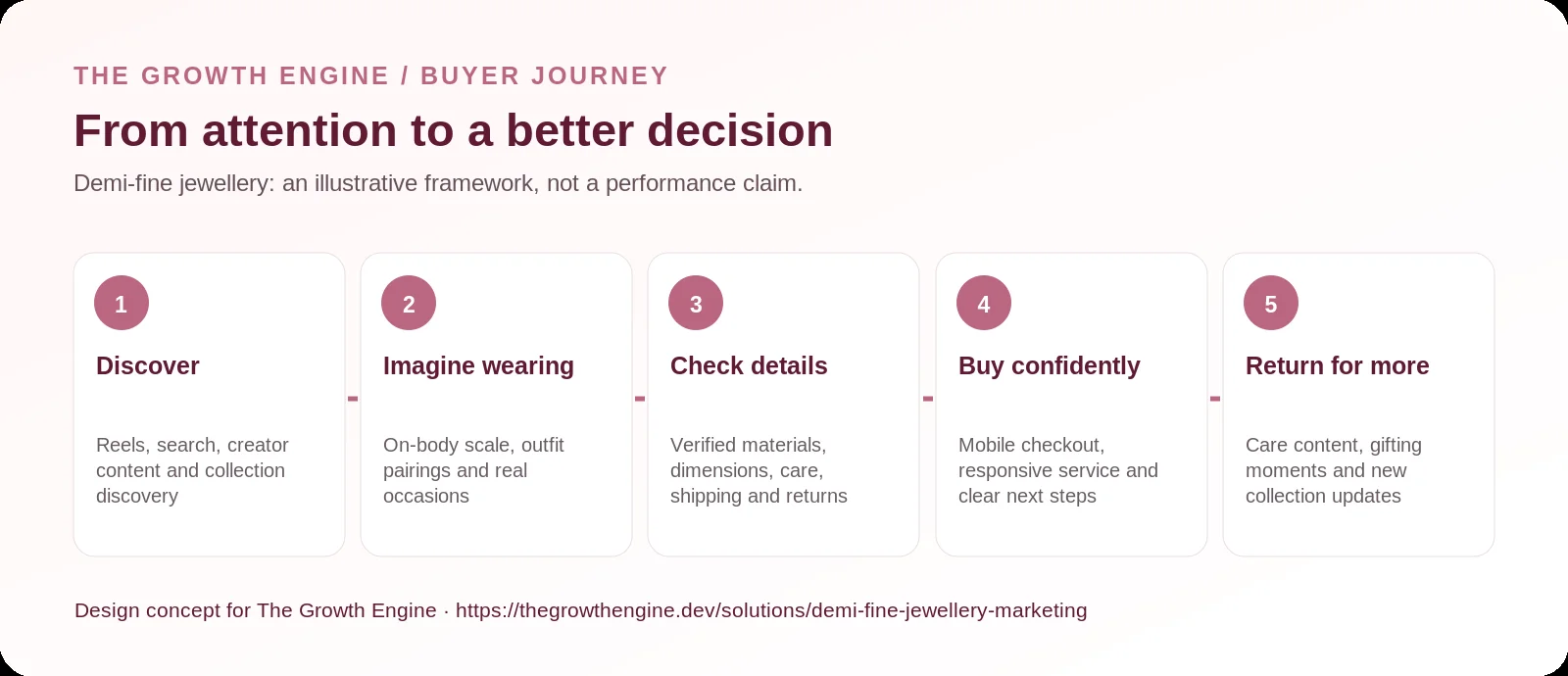
Measure progress, not noise
A great product page shows how a piece sits on the body, how it is made, what claims are verified, and what happens after checkout. You should never rely on unsupported anti-tarnish or hypoallergenic promises.
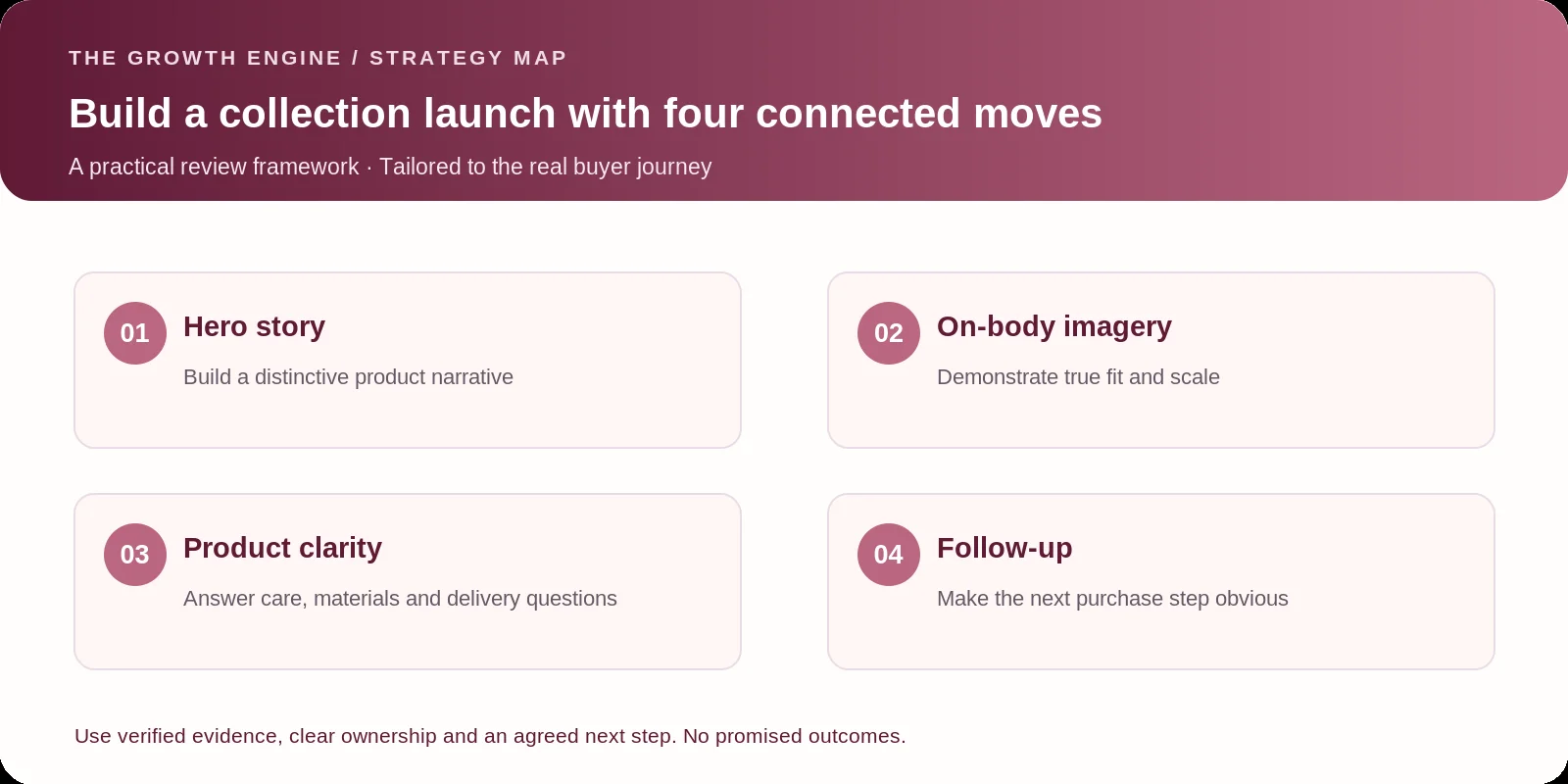
Show us the collection, channels and checkout experience. We will help pinpoint where content and commerce stop working together.
Related: qualified lead generation · SEO & AI search · client work · Growth Library
Common questions
Demi-fine jewellery marketing helps a brand explain and sell pieces that occupy a different position from disposable fashion accessories and traditional high-value fine jewellery. In a focused first planning discussion, buyers often care about styling versatility, verified materials, finish, price, comfort and how the item will hold up under appropriate care. Marketing should communicate the actual product rather than make sweeping durability claims. A good strategy connects visually distinctive content to detailed product pages and a straightforward purchase process. Useful measures include product-page engagement, qualified shopping intent, add-to-cart behaviour, purchase completion and repeat customers, interpreted alongside margin and customer feedback.
Begin with a precise design point of view and a recognisable customer occasion. Instead of posting interchangeable product photographs, build recurring formats: one piece styled three ways, close-up finish details, honest size comparisons, gifting advice and the story behind a collection. For a growing business today, use consistent framing and voice while varying compositions enough to stay interesting. Show products on real people or clearly labelled illustrative models, and verify details before publishing. Aesthetic consistency matters, but it cannot replace a clear reason to choose your pieces. Link every interested buyer to useful product information and an easy next step.
Short videos can demonstrate scale, movement and outfit styling; carousels can explain dimensions, material details and gift choices; product pages should answer the remaining questions. The best format depends on what customers need to know at that moment. A reel might create desire, while a size guide helps make the decision. For an agency and its client team, avoid relying solely on follower counts or saving a beautiful image. Review product clicks, conversations, cart actions and purchases where tracking is reliable. Test genuine customer questions as future creative ideas. That creates content grounded in shopping decisions rather than trend chasing.
Influencer partnerships may help when the creator speaks naturally to the audience your collection serves. In a focused first planning discussion, choose for genuine fit, content quality, audience relevance and disclosure practices, not just follower totals. Agree usage rights, deliverables, product information, creator approvals and how any commercial relationship will be disclosed. Track traffic and purchases carefully while recognising that attribution can be incomplete. A small number of thoughtful styling collaborations can be easier to learn from than a large batch of disconnected posts. Make sure creators understand the materials and do not claim properties that your brand cannot verify.
The page should show the piece clearly from several angles, on a person for scale, and with dimensions that buyers can use. Describe verified base metal, plating or finish where applicable, closure type, care, delivery, returns and any relevant warranty terms accurately. For a business reviewing its current buyer journey, a concise styling suggestion can help the customer picture the product in everyday life. Place the purchase action where it is easy to see on mobile. Do not substitute emotive copy for essential facts. Test whether shoppers hesitate over sizing, trust, checkout complexity or shipping expectations before redesigning every section.
Start with one collection proposition, an agreed target customer and a limited set of creative hypotheses. Separate campaigns meant to introduce the collection from those aimed at buyers already considering a product. Align the advertisement with the exact product or collection page instead of sending everyone to the homepage. At the beginning of a more deliberate growth project, confirm that materials, prices, inventory and policies are accurately represented. Measure useful outcomes such as engaged product visits, cart actions and purchases, alongside acquisition cost where data quality permits. Increase spend only when margins, fulfilment capability and the available evidence support it.
SEO may create discoverability around specific products, styling questions, gift occasions and material information. From a buyer's perspective, begin with understandable category pages and distinctive product descriptions rather than publishing many nearly identical articles. Technical essentials include crawlable product pages, fast mobile performance, descriptive image alternatives, sensible internal links and accurate structured data. Helpful guides can answer real questions about sizing, styling and care, with factual claims reviewed by the business. Search visibility develops over time and cannot be guaranteed. Judge the value of work against relevant visitors and assisted purchases, not the number of keywords inserted into a page.
Only use anti-tarnish language when the brand has a defensible basis and has defined what the claim means for that product. Some products may have finishes that behave differently under exposure, storage and care. For that reason, avoid promising that an item will never change appearance. Give customers accurate material and care information, plus applicable warranty or return conditions. Have a knowledgeable person review technical wording before it appears in ads or creator scripts. Trust grows when expectations match experience. If a claim cannot be verified, use straightforward descriptive language and clear photography instead of a stronger but unsupported promise.
Plan launch content around four stages: explain the collection idea, demonstrate the pieces on real people, make product details easy to evaluate and guide interested customers to checkout. Prepare photography, accurate inventory, mobile product pages, shipping information and customer-service responses before promotion. Use a short teaser only when the eventual buying path is ready. In a focused first planning discussion, during launch, monitor which pieces attract meaningful attention and where visitors hesitate. Continue with styling ideas, gift combinations and approved customer content rather than abruptly stopping communication. Treat the launch as a learning cycle, not a single day of announcements.
Yes, with consent and a purpose that benefits the customer. For an agency and its client team, WhatsApp can help answer product questions, confirm an enquiry, explain sizing or share an approved update about a requested collection. Avoid sending repetitive promotions to people who did not ask for them. Design clear response ownership and reasonable service expectations. Where appropriate, share a direct product link or an accurate answer rather than lengthy catalogues. Protect customer information and follow applicable messaging rules. Track whether conversations resolve problems or support orders, while recognising that not every purchase can be attributed to one message.
Track how people move from content to product understanding and purchase. Useful measures can include profile-to-site clicks, product-page views, size-guide use, add-to-cart activity, checkout completion, orders, returns and repeat customers. As part of a practical and commercially focused business growth review, interpret each number in context: strong saves may indicate inspiration, while frequent questions about materials may reveal unclear descriptions. Compare outcomes by collection and content angle where possible. Do not treat every last-click sale as proof that one post caused the purchase. The goal is better decisions about creative, merchandising and customer experience, not simply a more impressive dashboard.
DM selling can be useful at an early stage, but it may create repetitive questions and make product comparisons difficult as the catalogue grows. A website can organise available pieces, accurate details, pricing, delivery policies and payment options in one place. Customers can still ask questions through chat when they need help. For that reason, choose an ecommerce approach that matches order volume, inventory management and operational resources. Focus first on clarity and mobile usability rather than expensive visual effects. A website is valuable when it makes buying easier and customer service more consistent, not merely because competitors have one.
Give customers reasons to return that fit how they use the product. For a business reviewing its current buyer journey, useful post-purchase content can explain care, styling combinations and gift ideas; launches can introduce complementary pieces without overwhelming the customer. Make returns, service and communication reliable before building elaborate loyalty campaigns. Use opt-in email or messaging rather than assuming every buyer wants frequent promotions. Segment by real interests when customers have shared them, and avoid aggressive personalisation. Measure repeat orders and customer feedback by cohort where data is available. Retention grows from a good product experience supported by thoughtful communication.
Premium positioning does not require pretending the product is something it is not. Show design quality through distinctive imagery, cohesive packaging, careful descriptions, responsive service and verified product information. In a focused first planning discussion, explain style and construction clearly without implying precious metal content or certifications that do not apply. Communicate price in the context of what the customer receives and how the piece fits their life. A consistent visual system makes the brand recognisable, but honesty keeps expectations aligned. Compare your story against genuine customer motivations rather than copying luxury jewellery language that could mislead buyers about materials.
We would begin by reviewing the collection, intended customer, current channels and the points where attention fails to become a considered purchase. That may reveal a content-positioning issue, missing material information, weak mobile product pages or an unsuitable campaign path. We then agree on a focused scope that could include creative direction, content, conversion improvements, search or ongoing measurement. For an agency and its client team, the priorities depend on existing assets and operational readiness. The goal is a coherent buyer journey, not simply more posts. Any deliverables, third-party costs, approvals and success measures must be agreed before work begins.